Why ten minutes is the right length
An executive at a show is on the stand for perhaps an hour between meetings, a stage slot and a lunch with a distributor. Asking for thirty minutes gets a no; asking for ten gets a yes, and ten is enough. Three answers of 30 to 60 seconds each give an editor an opening, a product statement and a closing line. An executive who knows the slot is short relaxes into it.
The timing within the day matters as much as the length. Doors open at 10:00 and the first two and a half hours are the busiest on the stand, with visitors, press and walkthroughs competing for the same people. Between 13:30 and 15:00 the aisles thin out, the executive has eaten and the stage programme is usually in its quietest stretch. That is the slot to book. Avoid the last hour of the day, when everyone is tired.
Three questions, not ten
Ask why the company is at this show, what is new on the stand this year, and what a visitor should take away. Those three cover everything the editor needs. A fourth question, 'what surprised you today', produces the most human answer and often the best clip, because it is the only one the executive has not already answered in meetings all morning.
Do not send a list of ten questions for approval; it produces a scripted interview that reads as a press release. Send the three topics the day before, promise the executive a cut to approve before anything is published, and leave the exact wording to the moment. If the communications team insists on key messages, give them to the interviewer, not the executive; the interviewer can steer towards them with a follow-up question without the executive reciting them.
The setting on the stand
Choose a corner of the stand with the branding soft in the background and a metre or two of depth behind the speaker, so the logo reads without being sharp. Keep away from the demo station's speakers and from the LED wall, whose refresh can flicker behind a speaker on video. A lavalier microphone on the lapel isolates the voice from a hall that is loud all day; the camera microphone alone is not usable for a subtitled clip. A small light at forty-five degrees lifts the face out of the mixed hall lighting.
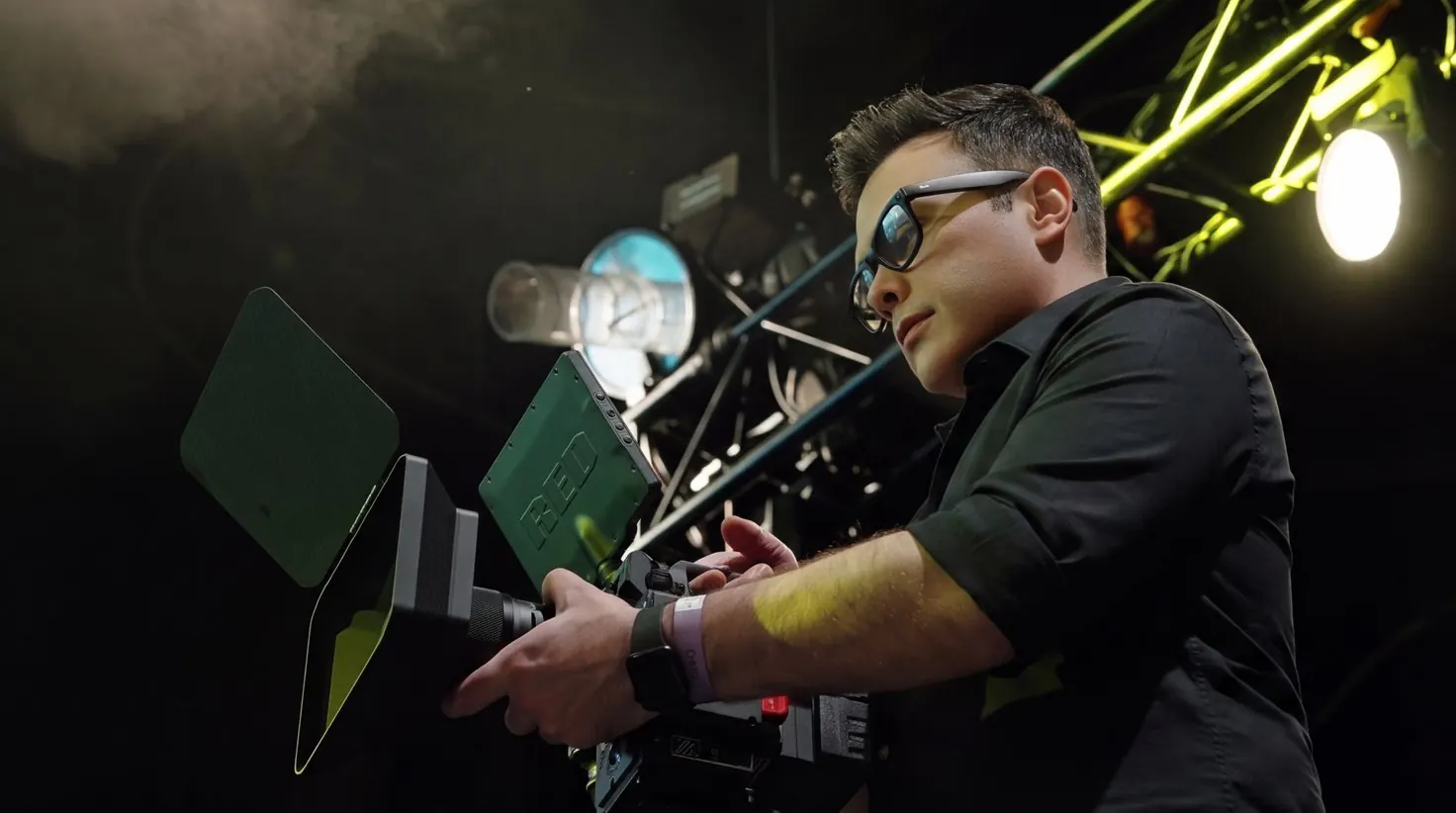
The camera sits at eye level, a little further from the speaker than feels natural, framed so that the vertical 9:16 cut works as well as the landscape one. The interviewer stands directly beside the lens so the executive looks near the camera rather than into it; the result reads as a conversation. A closed meeting room with no branding looks like any office anywhere; use it only if it has a glass wall or an open side. The on-site interview entry in the glossary covers the technical setup in more detail.
Directing without a script
Ask the executive to include the question in the answer ('We are at Arab Health this year because…') so each clip stands alone without a caption. If an answer runs past a minute, let it finish, then ask for the one-sentence version; that sentence becomes the vertical clip. If an answer is flat or corporate, ask 'what would you tell a customer who asked you that at the stand?' and record again; the second take is almost always the one used.
Watch for three things while recording: a colleague walking behind the speaker, the PA announcement that cuts across the best sentence, and the executive's hands, which should be free of a phone and a coffee cup. Stop at ten minutes even if the conversation is going well; that is what gets you a yes next year.
A ten-minute timeline at Arab Health
A medical devices exhibitor on a corner stand at Arab Health, CEO available at 14:00 between a distributor lunch and a 14:30 meeting. 13:45: the crew sets the light and the camera in the hospitality corner and checks the lavalier on a colleague. 14:00: the CEO arrives, the microphone goes on, thirty seconds of small talk while levels are set. 14:01 to 14:07: the three questions plus 'what surprised you'. 14:07 to 14:09: the one-sentence versions of the two answers that ran long. 14:10: microphone off, done.
That evening the CEO receives a link with a 45-second clip subtitled in English and Arabic and a two-minute version for the website. One comment back, a product name corrected in the subtitles, and the clip is on the company page the following morning while the show is still running. The subtitles entry explains how the two language tracks are delivered.
Mistakes we see
Interviews recorded at 11:00 in front of the running demo station: the audio is unusable and the speaker is constantly interrupted. A communications manager reading questions from a sheet two metres from the lens, so the executive's eyes wander across the frame. A ten-question list that produces eighteen minutes of footage and no usable 45 seconds. A dark suit against a dark back wall with no fill light. And the most common: no plan to approve the cut, so a good clip sits in a folder for a week and misses the show.
Each has a cheap fix: book the quiet slot, keep the interviewer beside the lens, send topics rather than questions, bring a light, and name the approver before the interview starts.
What happens to the footage, and what we need from you
Two cuts are standard: 30 to 60 seconds with subtitles in English and Arabic for LinkedIn, X and Instagram, and a two-minute version for the website, the distributor mailing and the sales deck. The executive receives both for approval the same evening, with one round of changes included. Usage rights for the company's own channels are included.
From you we need the executive's name and title as they should appear on screen, a 15-minute window agreed the day before, the name of the approver, and a signed consent form, which we bring; a template is on the resources page. The interview is part of a stand booking rather than a separate shoot; see trade show video production.
Quick answers
Should the CEO look at the camera during a trade show interview?
Usually not. Looking at an interviewer beside the lens reads as a conversation. Direct-to-camera works for a short scripted message, not for an interview.
What if the hall is too loud to record an interview?
A lavalier microphone close to the mouth isolates the voice; a quiet corner of the stand and a slot away from stage sessions and the demo station do the rest.
Can we interview the CEO in Arabic?
Yes. The interview is recorded in the language the speaker chooses and the clip is delivered with subtitles in English and Arabic.
How long should a CEO interview clip be for LinkedIn?
30 to 60 seconds, with subtitles, because most LinkedIn video is watched muted. A two-minute version serves the website and distributor mailings.
Can the CEO approve the clip before it is published?
Yes. The cut arrives the same evening by link, and one round of changes for subtitle corrections or a sentence to drop is included.
Questions about your show?
Send show, hall and stand number and what you need. You get a fixed quote within 24 hours.
info@lumiq.mediaLUMIQ Media & Marketing FZCO · Building A1, Dubai Digital Park, Dubai Silicon Oasis, Dubai
We reply within 24 hours. During a show week, WhatsApp is fastest.