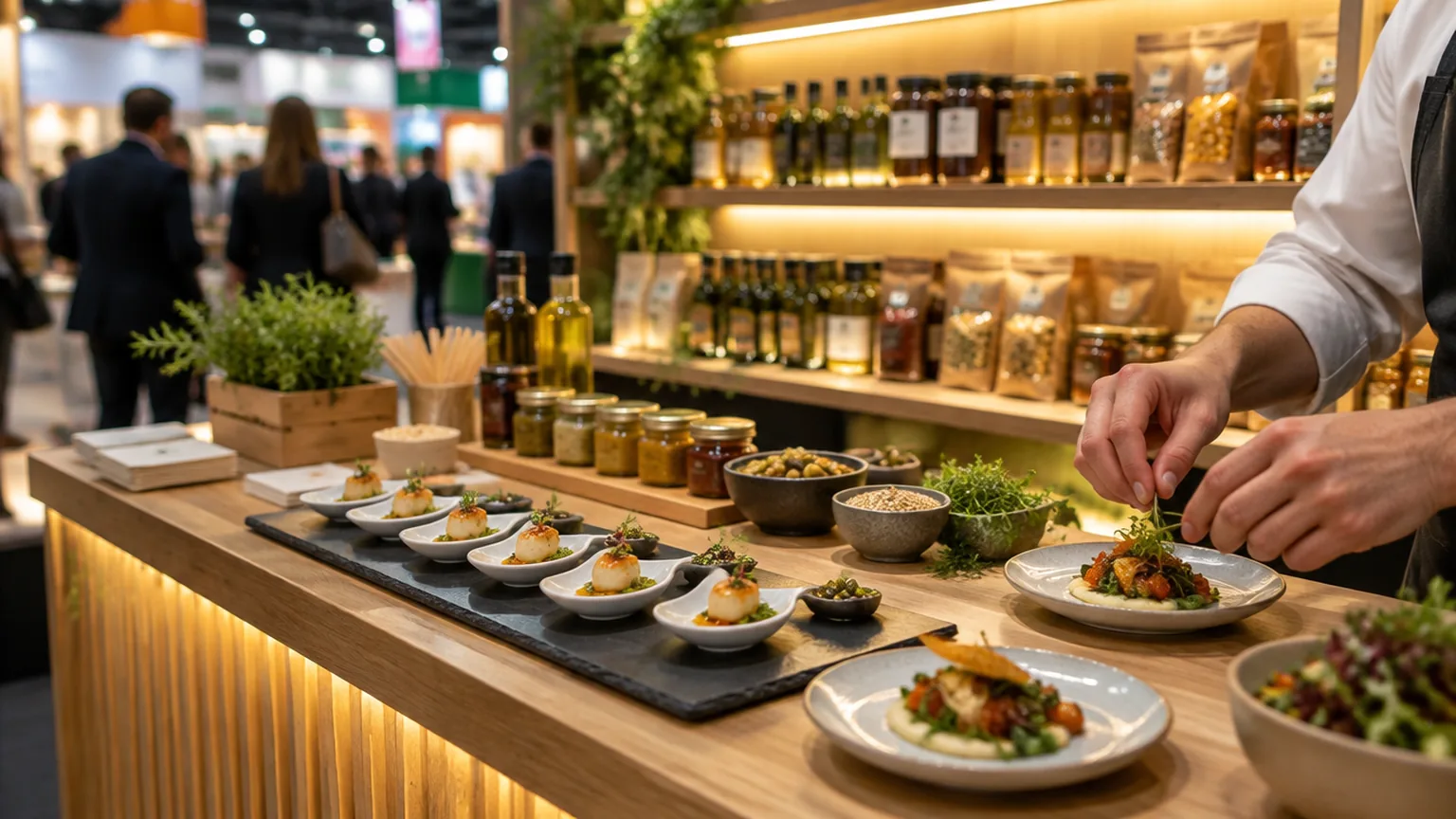
Why food is hard to photograph in a hall
Exhibition halls work against appetite. The light at Dubai World Trade Centre and Expo City comes from high above and is cool; the stand's own light is usually warm; the two together give food a grey or greenish cast that no buyer finds appetising. Halls are air-conditioned hard, so hot food stops steaming within seconds and cold drinks stop sweating. Counters are crowded, the chef is working, and the buyer who is tasting does not want a camera in the way. The method below works around all of this: controlled light for the product before doors, a long lens from the edge of the stand during tastings, and a few techniques for steam and condensation that apply only to the display frames, never to the samples people eat.
Product clean before opening
The stand becomes a product studio for forty minutes. Between 09:15 and 09:55 the crew sets a small light and a reflector at the counter and works through the range: packaging square to the camera on a white or brand-coloured background for the online store and the catalogue, then the product itself, opened, poured or plated, with a macro lens for texture, ingredients and the detail a buyer cannot see across a counter. A range of twelve products takes the full forty minutes; a range of forty needs a second morning or a reduced list agreed in advance. These images are delivered the same evening and are the ones that end up on the distributor's website six months later, so they are worth the early start. Have the packaging unopened and spotless, one of each flavour, and the chef's first plates ready by 09:30. The hero shot of the whole range is made last, when everything is in place.
Steam, condensation and the clean frame
Heat and cold are photographed, not felt. Steam reads only against a dark background with a little light from behind; against the white of a stand wall it disappears. For the clean frame of a hot dish the crew places a dark board behind the plate and a small light low behind it, and shoots within thirty seconds of plating. For cold drinks in the clean set a fine spray of water on the outside of the glass stands in for condensation the hall air will not produce. These techniques are used only on the display plates and glasses for the clean frames; nothing that a visitor eats or drinks is touched, sprayed or arranged. During the show, the real steam from a live cooking station is caught at the moment of the pour or the lift of a lid, and the crew waits for it rather than asking the chef to repeat.
Tastings and demos during the day
From the edge of the stand with a long lens, so the tasting continues as if nobody were photographing: the chef's hands, the pour, the sample handed over, the moment the buyer tastes and the reaction. The crew works through the busy hours, 11:00 to 13:00 and 15:00 to 16:30 at Gulfood, and takes eight to twelve frames of each tasting to get one with the right expression. Visitors whose faces will be recognisable in a published photograph are asked afterwards; most say yes, and those who do not are left out of the selection. Live cooking is filmed in short clips of five to ten seconds for the recap film and the vertical versions: the flame, the plating, the handover.
Buyers, signings and interviews
Distributor meetings are photographed discreetly from behind the exhibitor's shoulder, so the buyer is not identifiable unless they have agreed. Signings are photographed from two angles, the handshake and the documents, and filmed for five seconds. The export manager's interview is recorded in a quiet slot, usually 16:30 to 17:30, with a lavalier microphone, three or four questions, six to eight minutes recorded for a 60 to 90 second cut, subtitled in English and Arabic for the network of importers across the Gulf, Africa and South Asia. The distributor recruitment guide explains how the interview and the clips are used after the show.
A worked example: a dairy exporter at Gulfood
A cheese and yoghurt exporter has a 36 square metre stand at Gulfood with a chilled display, a tasting counter and a small meeting table. Day one, 09:15: the crew photographs the twelve products in packaging, then eight cut and plated, with the dark board for the two served warm. 09:50: the chef's first display plates and the range hero. 10:00 to 13:00: tastings from the edge, around 150 frames for 25 edited. 14:00: a signing with a Gulf retail buyer, two angles. 16:40: the export manager's interview. The evening link carries 70 edited photographs sorted into product, tastings, meetings and team. Days two and three add the busy counter, a second interview with the chef on the recipes, and the recap film with 9:16 cuts of the plating for Instagram. The same plan applies at GulfHost for equipment and at Gulfood Manufacturing for ingredients, where the product set is about packaging and process rather than plates.
What goes wrong, and what we need from you
- Packaging arrives dented or opened. Fix: one clean set of every SKU kept aside for the photographs, never used for sampling.
- The chef is not ready until 10:30. Fix: the first plates by 09:30 for the clean set, agreed the day before.
- Mixed light at the counter. Fix: the crew lights the clean set; for the day, a single colour temperature on the stand helps, see stand lighting for photography.
- Tastings interrupted for photographs. Fix: the long lens from the edge; the crew never asks a buyer to hold a pose.
From the client we need the product list in priority order, one clean set of packaging, the chef's first plates by 09:30, a named approver and the export manager's time for eight minutes. What arrives: the clean product set and the day's coverage the same evening, interviews with subtitles in English and Arabic, the recap film in 16:9 and 9:16, vertical clips of the plating and tastings, two revision rounds and usage rights for your own channels. See the food and beverage hub.
Quick answers
Can you shoot our packaging for the online store at the stand?
Yes, with controlled light on white or brand backgrounds, before the doors open. A range of about twelve products fits in the forty minutes; larger ranges take a second morning.
Do you photograph the tastings without interrupting them?
Yes, from the edge of the stand with a long lens. Nobody is asked to pose and the chef keeps working.
Gulfood is at two venues; do you cover both?
Yes, on one booking, with the crew split between Dubai World Trade Centre and Expo City Dubai or moving between them by arrangement.
How do you make hot food look hot in a cold hall?
A dark background and backlight for the clean frames, shot within thirty seconds of plating, and patience at the live station for the real steam during the day.
Do you need the chef to cook specially for the photographs?
Only the first plates for the clean set at 09:30. Everything else is photographed during the real tastings.
Questions about your show?
Send show, hall and stand number and what you need. You get a fixed quote within 24 hours.
info@lumiq.mediaLUMIQ Media & Marketing FZCO · Building A1, Dubai Digital Park, Dubai Silicon Oasis, Dubai
We reply within 24 hours. During a show week, WhatsApp is fastest.